

It’s 3:17 AM on a Friday.
You’re fast asleep. In the background, an attacker just slipped past your firewall using stolen credentials. They’re poking around your cloud environment, scanning for customer data, codebases anything valuable.
Now, let’s say your systems knew this was happening. Not just knew, but actively stopped it in its tracks. That’s what modern Endpoint Detection and Response (EDR) can do. And for startups and growing businesses, it’s one of the smartest cybersecurity investments you can make in 2025.
Antivirus Isn’t Enough Anymore
Antivirus and firewalls are like locked front doors. They stop obvious threats. But cybercriminals today are quiet. They get in through phishing, leaked credentials, or compromised software.

Endpoint Detection and Response (EDR) is your 24/7 motion detector, alarm, and rapid-response team inside the house.
EDR works by placing lightweight sensors on your critical devices, including:
- Laptops and desktops (Windows, macOS, Linux)
- Servers (cloud-based or physical)
- Virtual machines and containers
- Mobile devices (depending on the EDR platform)
- IoT and networked devices (selectively)
These sensors monitor behavior continuously. If they detect strange activity like unusual PowerShell scripts, off-hour logins, or privilege escalations they trigger alerts or take automatic action to contain the threat.
Some real-life examples of how EDR helped detect and prevent malicious threats.
International Committee of the Red Cross (ICRC) Cyberattack: The ICRC experienced a sophisticated cyberattack that went undetected for 70 days. Post-incident analysis revealed that while their existing anti-malware tools blocked some malicious files, most were specifically crafted to bypass these solutions. The breach was ultimately detected after the organization installed advanced EDR agents as part of a planned cybersecurity enhancement program. This case underscores the importance of advanced EDR solutions in identifying and mitigating complex threats.
Kroll’s MDR Implementation for a Plastics Manufacturer: A plastics manufacturing company concerned about undetected breaches enhanced its cybersecurity posture by implementing Kroll’s MDR services. This included deploying endpoint sensors across key assets, enabling proactive threat hunting, and providing 24/7 monitoring. The result was improved visibility across their hybrid cloud infrastructure and a significant reduction in potential security risks.
CrowdStrike’s Customer Success Stories: CrowdStrike has documented various instances where their EDR solutions have effectively thwarted cyber threats. For example, the Mercedes-AMG Petronas Formula One Team leveraged CrowdStrike’s technology to protect against sophisticated adversaries, ensuring the security of their high-value data and operations.
EDR vs. MDR: What’s the Difference?
EDR gives you visibility, analytics, and tools to respond to threats. But who’s watching the alerts when your team’s offline?
That’s where Managed Detection and Response (MDR) comes in. It’s EDR, plus a dedicated team of security experts monitoring and reacting in real time so you don’t have to.
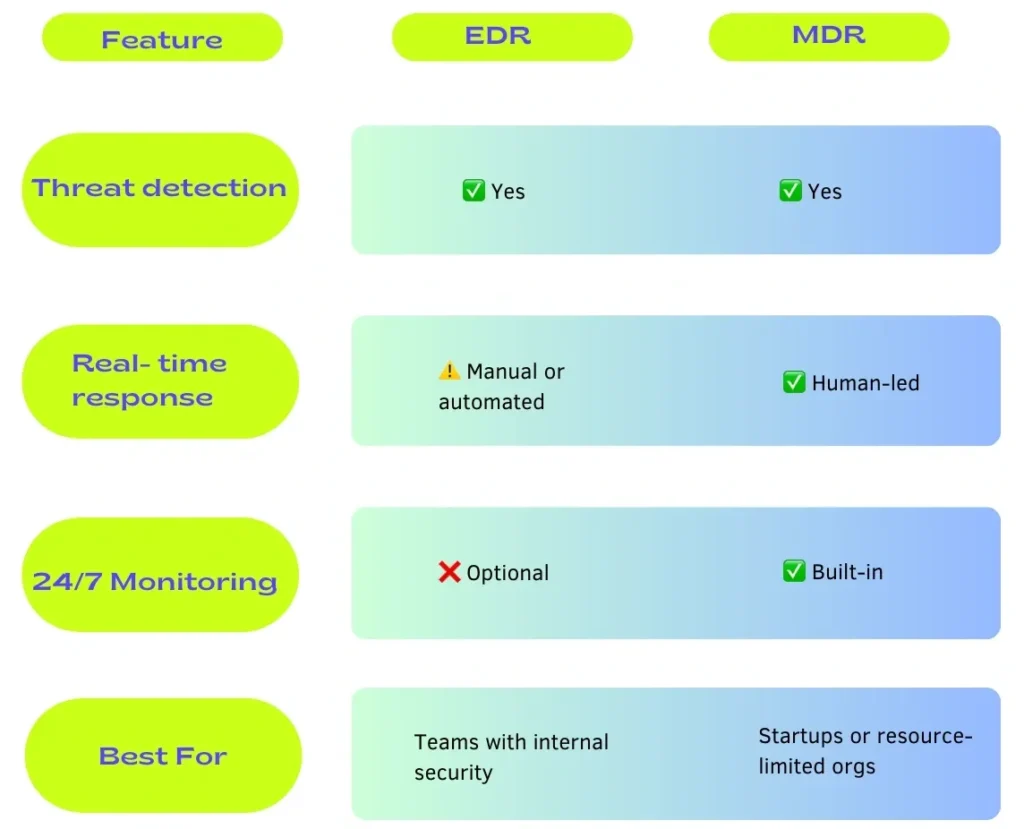
Startups and resource limited organisations without full-time SecOps teams typically benefit more from MDR. It’s like having a 24/7 security partner.
Why You Need This Right Now
- Startups are prime targets. Attackers assume you’re less protected and they’re often right.
- Security is key to winning big contracts and meeting compliance (SOC 2, ISO 27001, etc.).
- Trust is everything. One data breach can crush your reputation.
With EDR and/or MDR, you get:
- Full visibility into endpoint activity
- Early threat detection and rapid containment
- Post-incident forensics and threat intel
- Peace of mind even when you’re not watching
Cybersecurity isn’t just for enterprises. Startups are on the front lines, and without the right tools, it’s not a fair fight.
EDR gives you the power to see, stop, and understand attacks. MDR gives you the team to handle them.
If your current security strategy is just antivirus and luck it’s time to level up!!